
The Misuse of Intersectionality
How activists confuse intersectionality for "all lives matter," and then misuse it as an identity label or derogatory slur.

Intersectionality is often misrepresented as the idea that all forms of oppression are the same. This is common in activism spaces, where the term is misused to merge unrelated causes. For example, some argue that animal advocacy should include human issues and call themselves “intersectional,” effectively running an “all lives matter” campaign while misunderstanding the term entirely. Critics reacting to this often assume their misuse reflects what intersectionality actually means and respond by dismissing the concept entirely or using “intersectional” as an insult.
Kimberlé Crenshaw and others have repeatedly warned against using intersectionality to collapse distinct struggles, since doing so directly contradicts its purpose and meaning (Cho et al., 2013; Carbado et al., 2013).
What Is Intersectionality?
In the late 1980s, discrimination law treated racism and sexism as separate, mutually exclusive categories, forcing claims to fit one or the other. This left people who experienced both racism and sexism (e.g., Black women) without recourse.
Kimberlé Crenshaw introduced intersectionality to address this gap, showing that social categories (e.g., race, sex, gender, socioeconomic status) intersect in ways that produce distinct forms of discrimination and disadvantage that can’t be understood by examining racism or sexism in isolation (Crenshaw, 1989; 1991; 2006).
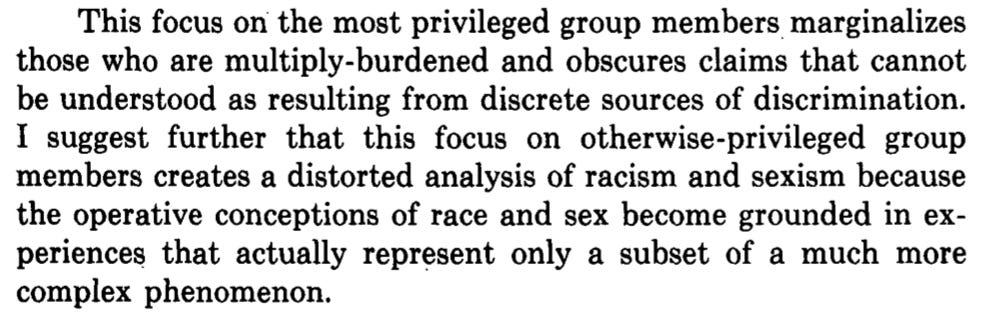
Put simply, intersectionality is about recognizing how individuals who belong to more than one marginalized group have different experiences. For example:
A Black woman can experience racism and sexism differently than a white woman or a Black man.
An Asian man with lower socioeconomic status can experience racism and classism differently than a wealthier Asian man or a white man.
Intersectionality has since been applied across various fields as a tool for identifying structural blind spots and improving the accuracy of research and interventions. Researchers have also used it to examine how other animals experience discrimination differently due to multiple biases (e.g., sexism, speciesism), cultural beliefs, perceived utility, and so on. For example:
Female animals (e.g., cows, pigs, goats, chickens) are subjected to sustained reproductive control in ways that differ from males (e.g., repeated forced impregnation).
Male chicks are killed immediately because they can’t lay eggs for profit, while female chicks are bred to lay hundreds of eggs per year (both exploited and violated as species, differently due to sex differences).
Male dogs (e.g., pit bulls) are subjected to harsher violence and higher euthanasia rates compared to other breeds or female dogs.
Mutual Confusion
Intersectionality highlights how experiences are not the same for everyone. Its purpose is to challenge reductive, black-and-white binaries that have long shaped how injustice is understood, not to rank experiences or lump them together in ways that erase those distinctions. However, given the human tendency to oversimplify, it’s often distorted in ways that directly contradict its purpose.
When people identify as “intersectional” and attempt to merge unrelated causes, this is similar to someone who claims to advocate for disability access, flattens all disabilities into one category, inserts disability into every unrelated issue, and then calls themselves an “accessibilityist,” a made-up identifier that signals concern while the behavior itself directly undermines accessibility.
The conflation of this behavior with intersectionality is also part of the problem. It shows up in “anti-intersectionality” posts that reduce the concept to “all lives matter,” treat “intersectional” as a slur, and in the rise of people calling themselves “non-intersectional,” which amounts to rejecting the recognition of distinct lived experiences and unknowingly making the very claim they are criticizing.
Essentially, it is like calling oneself an “anti-accessibilityist” because one opposes the behavior of those who call themselves “accessibilityists,” while demonstrating the same lack of awareness of what accessibility actually means. The aversion or rejection of intersectionality is a reaction to misrepresentation rather than a critique grounded in evidence or understanding.
Takeaway
It’s worth checking whether the term itself is the problem before dismissing it.
References
Carbado, D. W., Crenshaw, K. W., Mays, V. M., & Tomlinson, B. (2013). Intersectionality: Mapping the Movements of a Theory. Du Bois Review: Social Science Research on Race, 10(2), 303–312.
Cho, S., Crenshaw, K. W., & McCall, L. (2013). Toward a Field of Intersectionality Studies: Theory, Applications, and Praxis. Signs: Journal of Women in Culture and Society, 38(4), 785–810.
Crenshaw, K. (1989). Demarginalizing the intersection of race and sex: A Black feminist critique of antidiscrimination doctrine, feminist theory, and antiracist politics. University of Chicago Legal Forum, 140, 139–167.
Crenshaw, K. (1991). Mapping the margins: Intersectionality, Identity politics, and Violence against Women of Color. Stanford Law Review, 43(6), 1241–1299.
Crenshaw, K. W. (2006). Intersectionality, Identity Politics and Violence Against Women of Color. Kvinder, Køn & Forskning, 43(2-3), 7–20.
Superb breakdown of how both misuse and rejection stem from the same conceptual error. That accessibilityist analogy really clarifes the issue seeing activists flatten distinct struggles under one label while claiming intersectionality, then critics rejecting the whole framework because they misidentify what they're reacting to. Ran intothis exact dynamic working with advocacy groups where people would invoke intersectionality to merge completely unrelated campaigns, then wondered why it created more tension than solidarity.